Biodiversity
Management System
Policies
Biodiversity and Ecosystem Conservation Policy
POSCO surveys the potential impacts of our business activities on the biodiversity of surrounding areas and takes measures to minimize adverse effects.
New Projects
When undertaking projects such as facility expansions and additions, POSCO is committed to preventing and minimizing threats to biodiversity. Where necessary, we will restore affected areas and implement offset measures. We also strive to mitigate biodiversity loss and conduct surveys to monitor potential impacts. This commitment applies not only to our operational sites but also across both primary and non-primary supply chains. We recognize international conventions1) related to biodiversity and land protection, as well as relevant IUCN2) guidelines3), and comply with applicable national and local legal requirements at operational sites located within areas covered by such conventions. If our operations result in damage, loss, or degradation within protected areas subject to international conventions, we restrict access to the site and conduct a review. For operational sites that include natural or critical habitats, we seek to avoid adverse impacts on biodiversity by preventing and minimizing net loss, revising plans, or considering alternative locations. Prior to undertaking new projects, we conduct environmental impact assessments in accordance with applicable laws and regulations and identify and mitigate biodiversity-related risks, including potential impacts on endangered species. We are committed to ensuring that our business activities do not adversely affect biodiversity values such as ecosystems and critical habitats, and we engage in consultation with local residents and communities regarding land use.
1)Convention on Biological Diversity, Ramsar Convention, Convention Concerning the Protection of the World Cultural and Natural Heritage, etc.
2)IUCN(International Union for Conservation of Nature and Natural Resources)
3)IUCN Protected Area Categories guidelines, IUCN Guidelines for Planning and Monitoring Corporate Biodiversity Performance, etc.
Worksite Management
For operational sites that include habitats of importance to biodiversity, POSCO is committed to achieving No Net Loss and striving toward a Net Positive Impact. At Pohang Works and Gwangyang Works, we will assess pollution levels in marine waters and seabed sediments surrounding the steelworks, while continuing our efforts to conduct ongoing monitoring to support improvements in the local environment. Where necessary, we collaborate with specialized institutions to carry out expert studies on biodiversity-related impacts. We identify protected areas, areas of high biodiversity value, and endangered species located near our operations and project development sites, and use this information as a key basis for the development, implementation, and monitoring of biodiversity management plans for individual projects. Where conservation areas designated under international standards―such as World Heritage Sites or Ramsar Sites―or protected areas under international conventions are located within, adjacent to, or in the vicinity of existing operational sites, we strive to minimize any adverse impacts on the value of these protected areas.
Endangered Species Protection
POSCO supports biodiversity conservation initiatives at the local, national, and global levels as part of our commitment to protecting endangered species. We strive to protect endangered species located near our operational sites, including mammals and birds, and to conserve surrounding ecosystems through measures such as creating alternative habitats. We also enhance awareness and understanding of biodiversity protection among employees and relevant stakeholders through a range of environmental education programs.
TNFD Participation
POSCO joined the TNFD1) Forum as a member in June 2022, publicly affirming our commitment to biodiversity management and working to conserve biodiversity while minimizing our impact on business sites. To comply with TNFD guidelines and international conventions on biodiversity and land protection, we conduct ecological surveys near our worksites independently.
In particular, we are surveying water quality and bottom-sediment pollution levels in the marine areas near Pohang Works and Gwangyang Works, and when necessary, engage third-party agencies to conduct specialized biodiversity-impact assessments. When developing new worksites, we identify nearby protected areas and endangered species and incorporate this information into our biodiversity management plans. We do not pursue business activities in biodiversity-protected areas or wetlands, and for restoring nature affected by our operations, we review the application of BAT (Best Available Techniques) or recognized best practices.
In April 2024, we signed an agreement with the Ministry of Oceans and Fisheries to address marine desertification and created a Triton reef marine forests spanning approximately 229 hectares in the waters of Gupyeong 1-ri and Mopo-ri in Pohang. In November 2025, we applied marine-ecosystem restoration technologies at Jangnae Port in Taein-dong, Gwangyang, including planting 1,000 eelgrass seedlings and applying slag-based sea fertilizer. Going forward, we will continue to monitor the effects on marine desertification mitigation and coastal-ecosystem restoration, contributing to the development of a sustainable coastal ecosystem.
In addition, Gwangyang Works collaborates with the local community and relevant agencies to improve the ecological environment of a toad habitat near the worksite and leads efforts to prevent roadkill through migration-route cleanup activities. Through these field-based protection activities, we contribute to enhancing biodiversity and maintaining a healthy local ecosystem.
1)TNFD(Taskforce on Nature-related Financial Disclosures): A taskforce that encourages companies to quantify and disclose the financial impacts of nature-related risks and opportunities ― encompassing natural capital such as flora and fauna, air, water, and minerals
Management Activities
Ecosystem Risk Management Activities
Biodiversity Risk Assessment
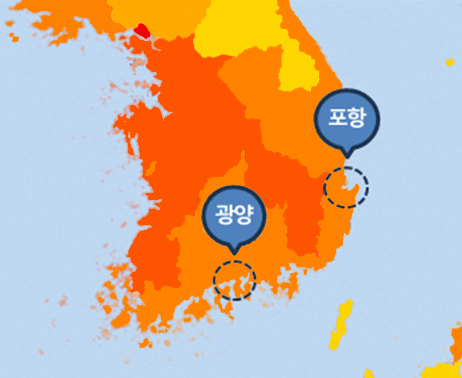
Based on the IUCN Red List, POSCO identified endangered species within a 5-kilometer radius of Pohang Works and Gwangyang Works. The Red List categories of Vulnerable(VU), Endangered(EN), and Critically Endangered(CR), represent species at risk of extinction, and among those identified near both worksites, fish were found to account for a significant proportion.
Biodiversity Risk Analysis Procedure
| STEP 1 | STEP 2 | STEP 3 |
STEP 4 |
STEP 5 |
|
|---|---|---|---|---|---|
| Steps | Industry-Specific Biodiversity Dependency and Impact Analysis | Identification of Biodiversity Status Near Worksites | Assessment of Site-Specific Biodiversity Risks |
Identification of Natural Capital Risks |
Monitoring of Biodiversity Status |
| Activities | Analyze the steel industry’s dependency on and impact to biodiversity using the ENCORE1) tool | Identify IUCN-designated endangered species, UNESCO World Heritage sites, and nearby habitats adjacent to the worksites | Assess biodiversity risks near the worksite using the WWF’s Biodiversity Risk Filter(BRF) |
Produce a comprehensive analysis of biodiversity risks |
Monitor, report, and review biodiversity Status |
1)A tool for systematically analyzing the dependencies and impacts between corporate activities and nature (ecosystems)
Biodiversity Management
POSCO uses the ENCORE tool to analyze and manage biodiversity-related dependencies and impacts specific to the steel industry.
Steel Industry’s Dependency and Impact on Natural Capital
Using ENCORE, POSCO conducted an initial analysis of biodiversity-related dependencies and impacts arising from the characteristics of the steel industry. Of the 20 items assessed for natural-capital dependency and impact, 11 were identified as falling at the Medium level or above1).
1)ENCORE classifies industry-specific dependencies and impacts on natural capital across five levels: very low, low, medium, high, and very high.
Anlalysis Results
| Category | Metric | Level | |
|---|---|---|---|
| Dependency | Supply Service | Water supply | High |
| Mitigating and Adjusting Service | Rainfall pattern regulation | Medium | |
| Water purification | Medium | ||
Water flow regulation | High | ||
Flood mitigation | Medium | ||
Impact | Pressure | Disturbance | Very High |
Emissions of GHG | High | ||
Emissions of non-GHG air pollutants | High | ||
Generation and release of solid waste | Medium | ||
Emissions of toxic pollutants to water and soil | Very High | ||
Volume of water use | Medium | ||
Status of Endangered Species Near Worksites
POSCO analyzes the status of biodiversity at-risk species for its major domestic worksites(Pohang Works, Gwangyang Works). It conducts systematic assessments using the IUCN Red List, centered on major natural-capital types such as biological resources(endangered species, biodiversity), water resources (river and wetland ecosystems), and forest resources(habitats, ecological corridors).
Analysis Timing and Method
POSCO updates its IUCN Red List database annually in April and May, filtering species by Red List categories(VU, EN, and CR) and classifying them by species group.
· [Red List Category] VU(Vulnerable), EN(Endangered), CR(Critically Endangered)
· [Land Region] East Asia - Republic of Korea
Number of Endangered Species(IUCN Red List)
| Category | Vulnerable(VU) | Endangered(EN) | Critically Endangered(CR) | Total |
|---|---|---|---|---|
| Pohang | 34 | 20 | 1 | 55 |
| Gwangyang | 43 | 31 | 4 | 78 |
| Category |
Mammals | Birds | Reptiles | Amphibians | Fish | Mollusks | Plants | Fungi | Other |
|---|---|---|---|---|---|---|---|---|---|
| Pohang |
5 | 16 | 2 | - | 25 | 1 | 4 | 1 | 1 |
| Gwangyang | 6 | 20 | 2 | 1 | 39 | 1 | 3 | 1 | 5 |
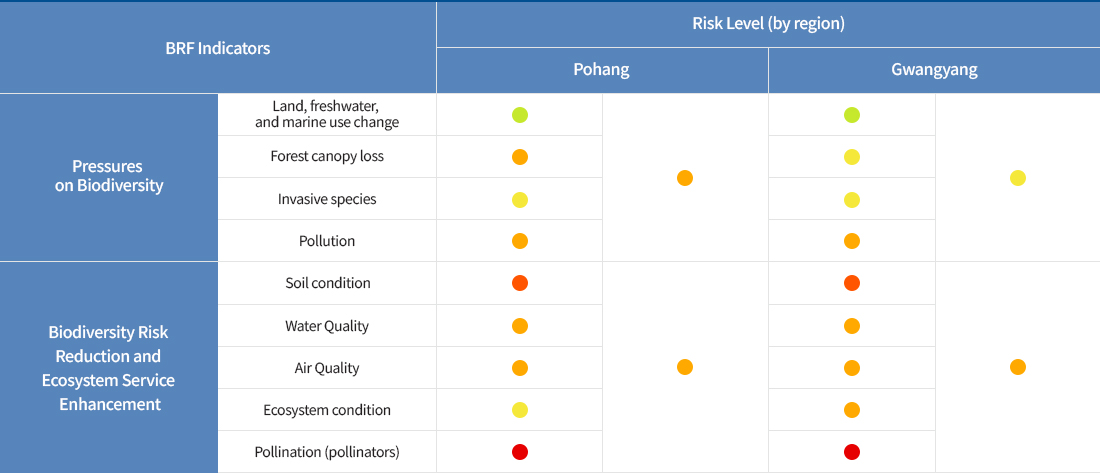
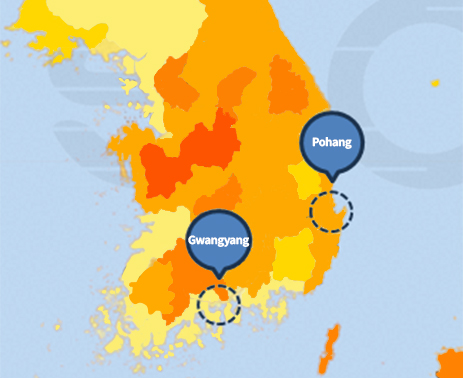
POSCO identified biodiversity risks in areas near our worksites by applying the WWF(World Wide Fund for Nature) Biodiversity Risk Filter(BRF), focusing on items rated at the 'medium' level or above for natural-capital dependency and impact in the steel industry, based on the biodiversity dependency and impact factors previously analyzed for the steel industry.
To comprehensively assess the health of local ecosystems and the effects of our business activities, we analyzed risks using two dimensions: Pressures on Biodiversity1) and Regulating & Supporting Services2), which covers risk mitigation and ecosystem-service activation.
1)Indicators that reflect ecosystem health, including risks to air, water, soil, and humidity. Lower risk levels represent a more stable ecosystem with greater resilience
2)Benefits derived from natural capital, including clean air, water, and mineral resources
Status of Endangered Species Near Worksites
Regional Biodiversity Risk Factors(source: WWF)
-
Pressures on Biodiversity
-
Biodiversity Risk Reduction and Ecosystem Service Enhancement
POSCO conducts annual marine-ecosystem surveys of areas near its worksites, focusing on the lower tiers of the ecosystem pyramid, including zooplankton and phytoplankton, attached macroalgae, and attached benthic animals. Since 2024, we have expanded the survey scope from 4 to 8 species, and the surveys of these lower-tier organisms confirmed a total of 377 species in the Pohang area and 330 species in the Gwangyang area.
Ecological Survey Results of Areas Near Steelworks(2025)
| Location | Phytoplankton | Zooplankton | Fish Roe | Larval Fish | Seaweeds | Attached Benthos | Macrozoobenthos | Nekton | Total |
|---|---|---|---|---|---|---|---|---|---|
| Pohang | 40 | 17 | 5 | 3 | 50 | 60 | 185 | 17 | 377 |
| Gwangyang | 70 | 30 | 4 | 2 | 49 | 34 | 132 | 9 | 330 |
Risk Mitigation by Environmental Impact Factor
An analysis of risk by possible environmental-impact factor(greenhouse-gas emissions, air, water, waste) derived accelerated climate change and odor generation as major impact factors. To mitigate the risk of the identified factors with large biodiversity impacts, POSCO carries out various activities such as reducing greenhouse-gas and air-pollutant emissions. The assessment is conducted once a year based on the results from ENCORE and WWF, and the assessment targets were selected as items whose risk value is measured as High.
Environmental Impact Assessment at Major Worksites
| Worksite Status | Biodiversity Decline Factors | Status Near Worksite(5 km radius) |
|||||
|---|---|---|---|---|---|---|---|
| Location | Area | Land use | Overfishing | Pollution | Invasive species | Accelerated climate change | UNESCO World Heritage area |
| Pohang | 9.5㎢ | Site preparation for facility expansion |
- |
[Air] pollutant emissions [Water] wastewater discharge and pollutant emissions [Chemicals] hazardous-chemical handling
| Pohang: 12 species, | [GHG emissions] | None |
| Gwangyang | 21.4㎢ | None |
|||||
Activities to Reduce Negative Biodiversity Impacts
| Category | Impacts and Risks | Major Mitigation Activities |
|---|---|---|
| Biodiversity Mitigating impacts |
GHG emissions |
|
| Atmosphere |
|
|
| Water Quality and Shortage |
|
|
| Waste |
|
Ecosystem Conservation Activities
Marine Ecosystem Conservation
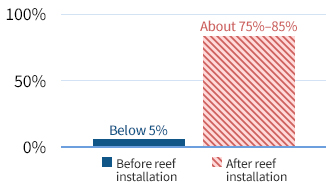
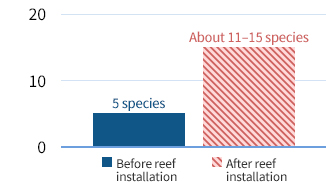
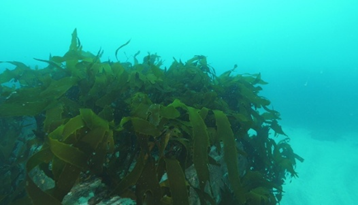
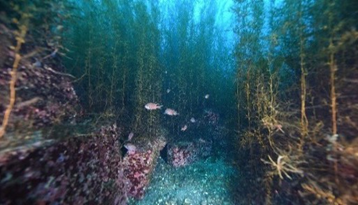
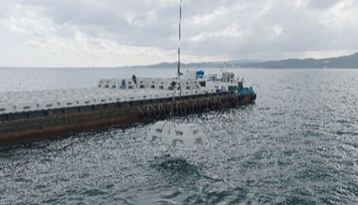
POSCO has been contributing to marine-ecosystem conservation and restoration for over a decade by producing Triton reefs from slag generated during the steelmaking process and deploying them in marine-desertification areas to create marine forests. Triton reefs are rich in minerals beneficial to marine ecosystems, such as calcium and iron, which promote seaweed growth and help prevent marine desertification. In response to the growing need to conserve and restore coastal ecosystems in Korea, where marine biodiversity is rapidly declining due to rising sea temperatures and barren-ground phenomena driven by climate change, we have designated severely desertified waters as priority targets for habitat conservation and restoration. To date, we have installed approximately 10,000 Triton reefs in coastal areas affected by marine desertification along the East and South seas, including Ulleungdo, Pohang, and the waters of Gupyeong 1-ri and Mopo-ri.
Going forward, we plan to conduct follow-up monitoring to track progress in mitigating marine desertification, restoring coastal ecosystems, and measuring blue carbon absorption, while continuing collaborative research to pursue international certification of blue carbon from seaweed and other marine forest vegetation. Our efforts in marine-ecosystem conservation and restoration through the creation of Triton marine forests have also earned international recognition. In 2023, POSCO became the first Asian company to receive the Environmental Innovation Award at the International Corporate Citizenship Conference(ICCC). In November 2025, our marine forest creation initiative was also featured as an outstanding biodiversity case from Korea in the newsletter of the UN-affiliated GPBB(Global Partnership for Business and Biodiversity).
Triton Sea marine(Pohang), Triton Sea marine(Ulleung) and Triton Reef Deployment
-
Changes in Seaweed Coverage at Ulleungdo and Pohang marine Forests
-
-
Changes in Inhabitant Species at Ulleungdo and Pohang marine Forests
-