Supply Chain
Governance
Organizational Structure
Group Supply Chain Management Council
To build a sustainable supply chain at the group level, POSCO operates a Group Supply Chain Management Council. Chaired by the head of POSCO's Corporate Procurement Division, the council brings together executives in charge of procurement at 11 group companies, including POSCO, POSCO International, POSCO E&C, and POSCO FUTURE M, and meets one to two times a year. Through the council, we discuss joint responses to key supply chain ESG issues and risks, thereby strengthening a consistent group-wide supply chain management system.

Activities
| Category | Details |
|---|---|
| Supply chain ESG risk management | Identify and assess potential ESG risks in the supply chain and develop ways to minimize them |
| Cooperation among group companies | Build partnerships to improve the sustainable competitiveness of the group supply chain |
| Sharing supply chain ESG performance and trends | gularly monitor supply chain ESG performance and share the latest supply chain management trends and techniques |
Shared Growth Organization
POSCO is building a robust steel supply chain and operating various programs to support shared growth with suppliers of equipment, materials, and raw materials, led by the Shared Growth Group under the Corporate Procurement Division. In addition, the Cooperation and Mutual Growth Group under the Labor and Cooperation Office leads shared growth efforts with service suppliers, while the Marketing Support Group under the Marketing Strategy Office drives shared growth initiatives with customers.

Supply Chain Management Policy
Supply Chain ESG Risk Management
POSCO operates a systematic ESG risk management process across the entire supply chain lifecycle―from supplier registration to performance evaluation and post-contract management―to prevent environmental, human rights, and other related issues.
Supplier Code of Conduct
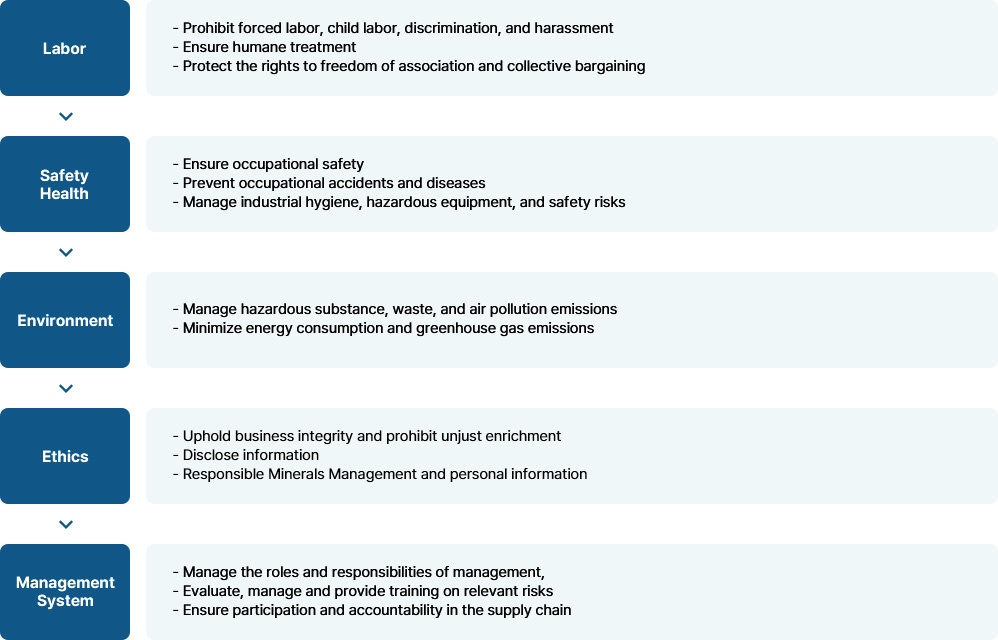
To secure supply chain sustainability, POSCO has established and operates a Supplier Code of Conduct. The Code is based on the Responsible Business Alliance (RBA) Code of Conduct and reflects POSCO's own standards, comprising 42 items across five areas: labor, safety and health, the environment, ethics, and management systems. The policy applies to all suppliers that directly transact with POSCO, and we distribute a separate guideline to enhance supplier’s understanding. Since 2024, we have disseminated the code through the e-Procurement purchasing portal enabling suppliers to agree to the Code and manage their own supply chain Code of Conduct compliance.
Key Contents of the Supplier Code of Conduct
Responsible Minerals
POSCO established its Responsible Minerals Policy and processes in accordance with the OECD Due Diligence Guidance and focuses on responsible mineral sourcing and stronger supply chain management. We require new suppliers to submit a statement of consent to the responsible-minerals policy upon registration, and when the country of origin is identified as a Conflict-Affected and High-Risk Area(CAHRA), we require trading only with smelters certified under the Responsible Minerals Assurance Process(RMAP), a global third party certification. To manage supply chain information, we require our own survey templates for suppliers and smelters, along with the Conflict Minerals Reporting Template(CMRT) and Extended Minerals Reporting Template(EMRT) provided by the Responsible Minerals Initiative(RMI). We have also published an annual Responsible Minerals Report since 2021.
· Responsible minerals: minerals mined in a socially responsible way that does not cause issues such as human rights abuses, environmental destruction, or funding for conflict groups.
· CAHRA: Regions with frequent social and ethical risks, including armed conflict, child labor, and human rights violations.
· CMRT: Reporting template for conflict minerals
· EMRT: Reporting template for extended minerals
Supply Chain Policy
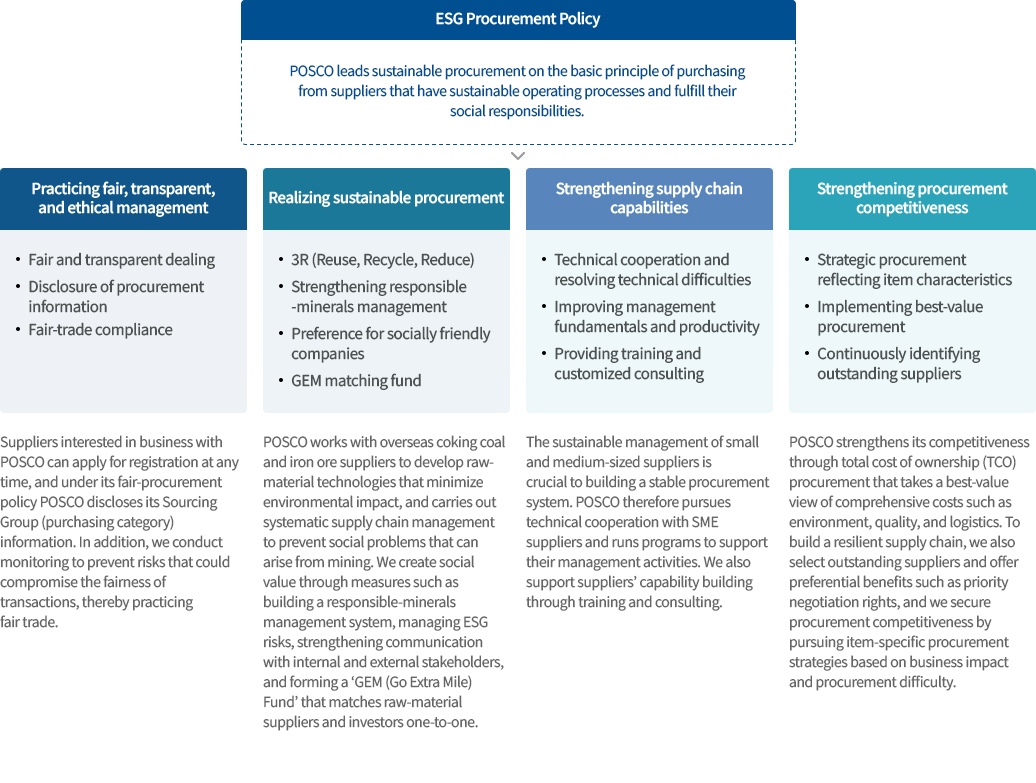
ESG Procurement Policy
POSCO implements a supply chain ESG procurement policy to improve sustainability across the entire supply chain.
Strategy
Risks and Opportunities
Supply Chain-Related Risks and Opportunities
POSCO selects and manages the supply chain as a material topic. We identify potential supply-chain-related risks and opportunities and carry out detailed response activities to address them.
| Type | Value Chain | Risk/Opportunity Factor | Description (incl. financial impact) | Detailed Response |
|---|---|---|---|---|
| Risk | Upstream | Trend toward broader application of safety and health management to supply chain workers and others | - Higher replacement costs from supply disruptions if safety incidents occur, and higher costs to support stronger safety management capabilities | - Operate regular safety communication channels for contractors' employees |
| Risk | Upstream | Tighter global supply chain management regulations | - Higher costs to secure new partners and manage the supply chain from supplier sanctions and worsening relations, and higher production costs from procurement delays | - Continuously monitor supplier risk through a supply chain risk management process spanning annual supplier ESG code-of-conduct consent, written due diligence, and on-site due diligence |
Opportunity |
Upstream |
Rising market demand for building supply chains based on long-term partnerships |
- Stronger partnerships and more stable raw-material procurement through improved supply chain ESG capabilities |
- Operate supply chain shared growth programs - Operate job training programs for suppliers |
Strategy and Response Measures
Supplier Management Process
POSCO operates a systematic ESG risk management process, from supplier registration through performance evaluation of contract fulfillment and follow-up management, to prevent environmental, human rights, and other related issues.

Always-on risk management
- ESG Risk Management : unethical practices, safety incidents, child labor, human rights violations, etc.
- Supply Risk Management: Follow-up actions after assessment, including monitoring changes in credit ratings
relative to registration standards, bidding participation performance, etc.
Step 1. New supplier registration
POSCO manages procurement items by Sourcing Group. The registration criteria for each Sourcing Group are continuously disclosed through MY POSCO, and suppliers seeking registration must agree to the Supplier Code of Conduct and the Special Terms and Conditions on Ethics. New supplier applicants are reviewed for any violations in areas such as environmental regulations, serious accidents, wage arrears, and tax payments, and are assessed against basic qualifications including credit rating, financial capacity, and supply capability. We subsequently conduct on-site inspections to verify actual operating conditions and, where necessary, carry out quality testing to confirm product reliability.
Step 2. Performance assessment
POSCO conducts the Supplier Relationship Management (SRM) evaluation―a supplier performance assessment―on a semi-annual or annual basis for all suppliers with transaction records. Based on the results, suppliers are classified into five grades (Excellent, Good, Average, Weak, and Poor), and supply chain management is tailored accordingly. Since 2023, we have also performed supply chain ESG due diligence to identify and improve ESG risks, including environmental and human rights issues, across the supply chain.
Step 3. Follow-up Actions
POSCO shares supplier performance evaluation reports with suppliers on a semi-annual or annual basis, providing feedback on their strengths and weaknesses and offering opportunities for improvement. Suppliers rated Excellent are eligible for selection as POSCO Honored Partner (PHP) suppliers, which entitles them to various preferential benefits, including priority negotiation rights and exemption from deposit payments. In contrast, suppliers rated Weak or Poor receive warnings or are encouraged to pursue voluntary improvements, and if their performance does not improve sufficiently, they are restricted from bidding for a period ranging from three months to one year
Supplier Risk Monitoring
POSCO continuously monitors its registered suppliers to maintain a robust supply chain and manage risks. Suppliers with ESG issues, such as environmental or safety concerns, may be subject to sanctions, including transaction suspension. POSCO may also revoke registration when a supplier's credit rating falls below grade B, when there is no bidding participation in the past year, or when there is no transaction record in the past two years.
Supply Chain ESG Due Diligence
Reflecting the EU Corporate Sustainability Due Diligence Directive (CSDDD) and the requirements of global ESG rating agencies, POSCO established a supply chain ESG due diligence process in 2023. Suppliers subject to due diligence are selected based on a comprehensive assessment of transaction volume and ESG risk level, and the process is conducted through both written due diligence and on-site due diligence
The due-diligence items broadly cover labor and safety areas such as compliance with safety and health regulations, completion of mandatory safety training, and health check-ups, as well as environmental factors such as environmental-permit compliance, carbon emissions, and water management. They also include governance factors such as ethics and management systems, ensuring a comprehensive review of ESG management. In 2025, we selected 535 companies for written due diligence and completed assessments of 457 of them, achieving an 85.4% due-diligence rate. For suppliers identified as high-risk through the written review, we conduct on-site due diligence in partnership with third-party assessment agencies. Based on the findings, we provide recommendations on areas requiring improvement, helping suppliers strengthen their capabilities in a tangible way.
Supply Chain ESG Due Diligence Process

Supply Chain Shared Growth Programs
Benefit Sharing Program
Since introducing the Benefit Sharing System for the first time in Korea in 2004, POSCO has carried out joint improvement activities with partner companies and shared the resulting benefits. Participating companies receive 50% of the financial gains generated from the projects in cash, along with various incentives including long-term supply contracts of up to five years―contributing to their technological development and revenue growth.
Shared Growth Consulting Section
Launched in 2021, the Shared Growth Consulting Section is a dedicated SME consulting body composed of in-house experts with an average of over 25 years of experience across POSCO's various business areas. The Section offers tailored consulting in areas of interest to SMEs―such as smart factory implementation, ESG management support (including safety and energy efficiency), facility and process optimization, and quality issue resolution―by drawing on the expertise and know-how of its consultants. In particular, through the Ministry of SMEs and Startups' 'Win-Win Smart Factory Program for Large and Small Enterprises,' POSCO helps SMEs adopt advanced IT technologies and pursue AI Transformation (AX) at their manufacturing sites.
Enhancing diversity in the supply chain
To promote social value, POSCO grants preferential treatment to socially responsible enterprises in new supplier evaluations. Specifically, the Sourcing Group registration threshold is lowered for socially responsible enterprises led by women and individuals with disabilities.
POSCO Honored Partner (PHP) Program
Through a comprehensive evaluation that includes Supplier Relationship Management (SRM), POSCO annually selects outstanding suppliers of equipment, material, and raw-material and certifies them as PHP (POSCO Honored Partner) suppliers. PHP suppliers receive benefits such as exemption from guarantee bonds when contracting and preferential steelworks access, as well as support using the POSCO Group's global network when entering overseas markets. PHP suppliers also organize the 'POSCO PHP Volunteer Group' to carry out diverse social contribution activities and pursue shared growth with local communities.
Financial support for partners
POSCO operates a Shared-Growth Fund to help improve the business conditions of its partner companies. The Shared Growth Fund, jointly established with banks and partner companies that share POSCO's vision, consists of the Low-Interest Loan Fund and the Steel Industry ESG Win-Win Fund, both of which provide SMEs with financing at lower-than-market interest rates.
The Low-Interest Loan Fund, totaling KRW 570 billion, was established with four commercial banks (IBK, KDB, Woori, and iM Bank) and offers loans of up to KRW 4 billion to SMEs. The Steel Industry ESG Win-Win Fund was jointly established by POSCO, Hyundai Steel, and IBK to provide financing for ESG management initiatives at SMEs in the steel industry. In 2024, the fund was expanded from KRW 150 billion to KRW 200 billion, providing loans of up to KRW 2 billion for up to three years to SMEs seeking to strengthen their ESG capabilities.
In addition, POSCO became the first private-sector company in Korea to introduce the Win-Win Payment System for subcontracting in 2009. By paying subcontracting fees and labor costs directly to second-tier partner companies and workers, we fundamentally eliminates the risk of payment delays and non-payment.
Fostering ventures and talent
Beyond supporting its suppliers, POSCO has established CHANGeUP GROUND, a hub dedicated to fostering technology-based venture companies, to help strengthen the future value chain and balanced regional development. In 2021, using the infrastructure of the POSCO Group (industry), POSTECH (academia), and the Research Institute of Industrial Science & Technology (RIST) (research), we opened CHANGeUP GROUND Pohang, and in 2025, in cooperation with Gwangyang City, we also opened CHANGeUP GROUND Gwangyang. We also run 'POSCO IMP (Idea Market Place),' the first nationwide program by a large company to discover and foster promising venture companies, and an in-house venture program that gives group employees the chance to start businesses. To support the scale-up of venture companies in incubation, we also run various programs such as prototype production, attracting investment, and opening sales channels.
In addition, we lead efforts to solve youth employment problems and ease local SMEs' recruitment difficulties through the SME Consortium program, a job-support program that uses our own education and training infrastructure to give young job-seekers the practical training they need and immediately connects them to partner SMEs that are hiring.
Shared Growth Performance(2025)
| Program | Key Performance | |
|---|---|---|
| Benefit Sharing Program | KRW 51.7 billion provided | |
| Shared Growth Consulting Section | 140 tasks supported | |
| PHP System | 10 PHP volunteer activities held | |
Partner financial support | KRW 643.6 billion in loans | |
| Low-interest loan fund | KRW 540.3 billion |
Steel Industry ESG win-win fund | KRW 103.3 billion | |
Venture investee companies | 72 companies participated | |
Highest Rating in the Win Win Growth Index
POSCO has earned the highest rating of "Excellent" on the Win-Win Growth Index1) for six consecutive years.
1)An evaluation index established by the Korea Commission for Corporate Partnership to foster a culture of shared growth between large corporations and SMEs.
Job Competency Training Program for Partners
POSCO offers training programs to develop basic job competencies for employees and young professionals working at SMEs, including its suppliers.
- Training content: Fundamental job competencies for employees and young professionals at SMEs, including suppliers
- Training Participants: 479 partner companies(including suppliers and subcontractors) under training agreements
- Training Perfromance: 15,202 participants completed in-person training in 2025
Training Program Types
| Category | Consortium training (2005~) | Company-tailored training (2020~) | Work-learning dual training (2015~) | Pre-hire training (2014~) |
|---|---|---|---|---|
| Concept | - Enhancement of fundamental job skills through industry-led, region-based vocational training infrastructure | - Design and operation of training courses through job analysis of partner companies | - Field-based training combined with on-the-job training (*consortium Off-JT training provided) | - Job-readiness program for young job-seekers
|
| Target | - All employees of partner companies | - All employees of partner companies | - New hires within one year of joining partner companies | - Young job-seekers |
| Content | - Acquisition and development of on-site technical skills (machinery, electrical, welding, crane, etc.) plus organizational management, leadership, safety, ESG innovation, character development, etc. | - Analyze core jobs and support training-roadmap design, provide career-development paths, and offer an HRD guide | - 16 job types related to the National Competency Standards (NCS), such as machine elements, power machinery, forklift, and crane | - Workplace fundamentals such as character, communication, and vision design, plus understanding of steelmaking processes and facilities and machinery/electrical theory and practice |
|
Hours |
4+ hours per person, in-person |
4+ hours per person, in-person |
200 hours per person (one-year program), in-person |
350 hours (two months), residential program |
Supplier Training Performance
| Year | Training Performance(cumulative, persons) |
|---|---|
| 2023 | 696,044 |
| 2024 | 717,987 |
| 2025 | 733,189 |
Operating Supply Chain Grievance Channels
POSCO operates the ‘Open Procurement Counseling Portal’ within its electronic procurement system, ‘e-Procurement’, to continuously receive inquiries and grievances from contractors. Reporters are protected from any form of disadvantage, including identity disclosure or retaliation.
External stakeholders can also submit feedback - either anonymously or under their real names - through various channels such as the ‘Unethical Conduct Reporting Center’ on the company website. Once the facts of a reported case are verified, active response measures are taken through monitoring and due diligence. In 2025, a total of 23 inquiries and grievances were received through the Open Procurement Counseling Portal, all of which were successfully resolved.
Contractor Communication Channel
POSCO maintains an open approach to addressing various inquiries and grievances from partner companies regarding registration, performance evaluation, and related matters. Dedicated personnel are assigned to facilitate real-time communication regarding any concerns, while the 'Open Procurement Counseling Portal' within the 'e-Procurement' system also serves as a channel for collecting feedback and providing responses to partners.
(Procurement Division: +82-54-220-5000 | Partner Relations Division: +82-54-220-7000)
Risk Management
Supply Chain Risk Management Process
Responsible Minerals Risk Assessment
In accordance with POSCO's supply chain management process, POSCO systematically tracks supply chain information, including the country of origin, locations of mines and smelters, and transportation routes. Suppliers identified as high-risk through risk assessments are managed in accordance with established risk response protocols. In addition, POSCO has published an annual Responsible Minerals Report since 2021, transparently disclosing the results of all related activities.
Responsible minerals use (as of 2025)
| Mineral | RMI Smelter ID | Smelter Name | Country of Origin | RMAP Certification |
|---|---|---|---|---|
| Tin | CID001477 | PT Timah Tbk Kundur | Indonesia | Certification |
| Tin | CID001482 | PT Timah Tbk Mentok | Indonesia | Certification |
Tungsten | CID002315 | Ganzhou Jiangwu Ferrotungsten Co., Ltd. | China | Certification* |
CAHRA Management Status(as of March 2026)
| Regions | Countries | Areas |
|---|---|---|
| Africa | 17countries | 184 |
| Asia | 5countries | 56 |
| Middle East | 2countries | 23 |
South America | 2countries | 36 |
Europe | 2countries | 12 |
Total | 28countries | 311 |
Responsible Minerals Management Process

Metric and Targets
Metric
Supplier ESG Due Diligence Status
| Due-diligence target | Due diligence completed | Due-diligence rate |
|---|---|---|
| 535 companies | 457 companies | 85.4% |