Climate Change
Governance
Organizational Structure
Dedicated Organization
Climate change response is embedded throughout POSCO's decision-making system. Chaired by the CEO, the Carbon Neutrality Committee serves as the control tower for climate response, reviewing each department's progress on decarbonization measures and coordinating issues that arise during execution. The monthly company operating meeting monitors greenhouse gas emissions performance alongside the impact of climate change response on the company.
The Technology Strategy Office, reporting directly to the CEO, handles decarbonization strategy, technology development, and implementation checks through the five subcommittees under the Carbon Neutrality Committee. To shift effectively to a low-carbon steel production system, we operate the HyREX Project Team, which oversees the hydrogen reduction ironmaking business, and the Electric Arc Furnace Project Team under Gwangyang Works.
Climate Management System

Control and Procedures
Performance Management and Compensation Linkage
POSCO evaluates executives against KPIs alongside key performance outcomes, with executive compensation determined accordingly. Total carbon emissions are incorporated as a key target within our ESG evaluation criteria.
Environment-related KPI Linkage
| Responsible | KPI | Evaluation Cycle |
|---|---|---|
| All executives (incl. CEO) | Total carbon emissions | Annual |
Climate Risk Review at the Investment Stage
POSCO introduced an internal carbon pricing system in 2024 to manage climate-related risks and opportunities and prepare for the transition to a low-carbon business structure, and has since operated it in a systematic manner. The internal carbon price serves to heighten awareness of climate change among executives and employees and to assess the economic feasibility of investments and project development. The price is periodically updated to ensure timely responses to market changes.
Strategy
Risks and Opportunities
Climate-related Risks and Opportunities
POSCO has established a climate risk response system to minimize the financial impacts of physical and transition risks associated with climate change. Following the TCFD framework, we manage climate-related risks and opportunities through four key pillars: governance, strategy, risk management, and metrics and targets.
| Type | Risk/Opportunity Factor | Description (incl. financial impact) | Detailed Response |
||
|---|---|---|---|---|---|
| Risk | Transition | Policy & Regulation | Intensification of ETS1)and reduction of free allocation | Increase in costs due to reduced free allocation and higher paid ratio upon entry into the 4th planning period | Introduction of internal carbon pricing; establishment of GHG forecasting and reduction plans; development of blast-furnace carbon-reduction technology |
| Full implementation of CBAM2) | Generation of carbon costs on steel exports upon full implementation of CBAM in 2026 | Completion of the Gwangyang Electric Arc Furnace (2.5 million-ton scale); |
|||
| Market | Rising demand for low-carbon steel supply | Necessity of timely response to growing customer demand for low-carbon steel | Development of low-HMR4) technology, EAF scrap melting and charging, and EAF high-grade steel production |
||
Intensification of competition in global raw-material supply chains | Intensifying global competition to procure raw materials such as pellets and HBI5) | Investment Review of Overseas HBI Project; expansion of scrap collection bases and sorting centers | |||
Technology | Initial investment burden of hydrogen-based ironmaking | Necessity of large-scale investment for HyREX6) and facility conversion, with requirement of long-term verification | Construction of the HyREX demonstration plant | ||
Limits of high-grade EAF steel technology | Existence of refining-technology limits in producing high-grade EAF steel | Development of high-grade EAF steel production technology | |||
Uncertainty in CCUS3) process technology | Uncertainty in CCUS efficiency and process-integration technology | Participation in government CCUS projects; expansion of the demonstration base | |||
Physical | Acute | Coastal flooding and river overflow | Risk of recurring flooding at Pohang's Naengcheon stream and the Gwangyang coast | Establishment of a BCP7); strengthening of flood barriers and drainage infrastructure | |
Opportunity | Transition | Products & Services | Growing demand for low-carbon steel | Generation of revenue growth from meeting market demand for low-carbon steel | Expansion of low-carbon steel supply; advancement of low-carbon steel standardization through the K-Steel bill and similar measures |
Resource Efficiency | Facility efficiency and use of scrap and by-product gas | High-efficiency facilities and possibility of energy savings | Rationalization of thermal power generation; optimization of hot-blast control; expansion of by-product gas recovery | ||
1)ETS(Emissions Trading Scheme)
2)CBAM(Carbon Border Adjustment Mechanism)
3)CCUS(Carbon Capture Utilization, and Storage)
4)HMR(Hot Metal Ratio)
5)HBI(Hot Briquetted Iron)
6)HyREX(Hydrogen Reduction Ironmaking)
7)BCP(Business Continuity Plan)
Strategy and Response Measures
Decarbonization
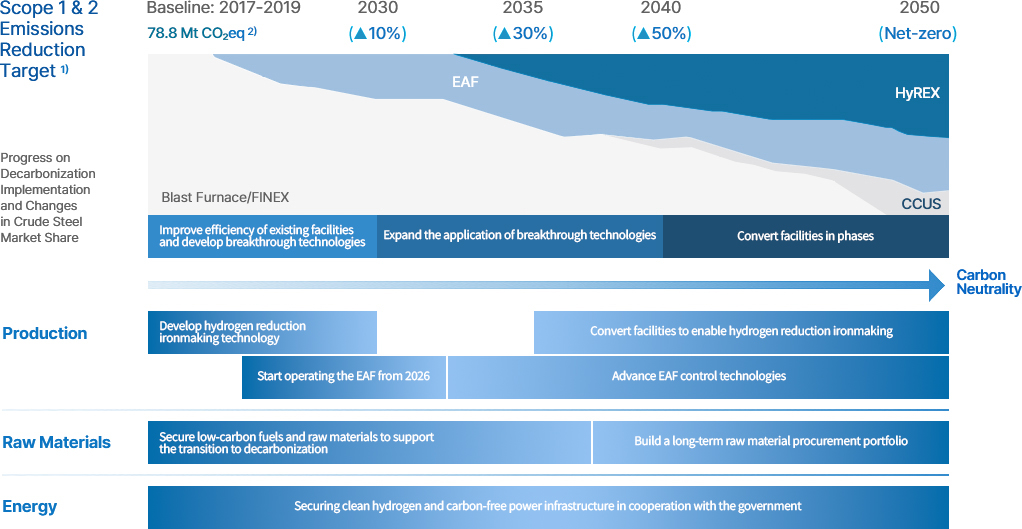
POSCO is advancing toward its decarbonization goals under the 2050 Decarbonization Roadmap, a comprehensive mid- to long-term strategy covering technology development, facility investment, raw material sourcing, and energy procurement.
In the short to medium term, we plan to utilize existing facilities to expand the use of carbon-reduced fuels and raw materials, while applying bridge technologies such as hydrogen injection into blast furnaces and low-HMR (Hot Metal Ratio) operations. We will also introduce a new Electric Arc Furnace (EAF) at Gwangyang Works in 2026 to respond to growing customer demand for low-carbon products.
In the long term, we aim to gradually adopt HyREX(Hydrogen Reduction Ironmaking), our proprietary hydrogen reduction ironmaking technology, supported by a stable hydrogen and power infrastructure.
Our carbon emissions target for 2025 was 74.9 million tons, while actual emissions totaled 69.8 million tons (Scope 1 and 2).
Decarbonization Roadmap
1)The above information is subject to change depending on internal and external circumstances
2)The baseline figure refers to the average total emissions from POSCO’s domestic operations over the period 2017-2019
1. Blast Furnace-based Carbon Reduction Technology
Carbon-Reduced Raw Materials
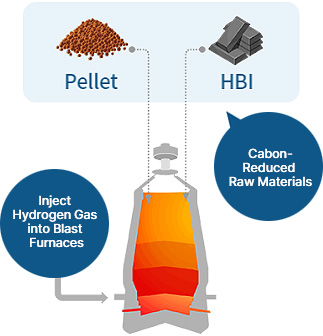
The iron ore used in blast furnaces is mainly classified into sinter and pellets, with sinter accounting for the largest share at over 70%. Pellets are iron ore that has been crushed, screened, and processed into uniform spheres. Replacing sinter with pellets as a blast furnace feedstock can reduce the use of fossil fuels required for sinter production.
HBI (Hot Briquetted Iron) is a reduced iron material produced through a process that removes oxygen from iron ore. Charging HBI into a blast furnace can reduce the amount of coking coal required for the reduction process. To secure a stable HBI supply chain in a timely manner, we participate in overseas HBI projects and plan to actively utilize HBI in the production of our low-carbon products.
Hydrogen-Enriched Gas
Injecting natural gas (NG) in place of coking coal into a blast furnace leads to the decomposition of methane (CH4), the main component of natural gas, producing carbon monoxide (CO) and hydrogen (H2). The resulting hydrogen-containing gas can be injected through the tuyeres at the bottom of the blast furnace and used as a reducing agent, thereby reducing coking coal consumption.
We secured blast furnace NG injection technology in the first half of 2023 and plan to continue developing hydrogen-enriched injection technology.
2. Converter-based Carbon Reduction Technology
A converter is a large vessel-shaped facility that holds molten iron (hot metal) produced in a blast furnace, in which oxygen is blown in to remove impurities and produce molten steel refined to the desired composition. Assuming that the total carbon generated in producing one ton of molten steel is 100% on a Scope 1 and Scope 2 basis, approximately 80% arises during the production of hot metal. therefore, converter-based carbon reduction technology aims to reduce the amount of hot metal used in the converter and increase scrap usage. There are two main ways to reduce the amount of hot metal in the converter.
Molten Scrap Charging Technology
The first is scrap melting and charging technology, which pre-melts scrap for use in the converter to increase the scrap ratio. An Electric Arc Furnace(EAF) steelmaking relies primarily on recycled scrap as its input material, and therefore requires less coal and iron ore compared to blast furnace-based steelmaking. However, EAF steelmaking is limited in producing high-grade products depending on scrap composition and impurity levels; therefore, high-grade steel such as automotive sheet and shipbuilding heavy plate is still mainly produced by refining blast-furnace hot metal in a converter. We plan to develop and apply melted scrap charging technology, which mixes hot metal from the blast furnace with molten steel from the EAF. This technology will use the EAF at Gwangyang Works, which begins operation in 2026.
Oxygen Top & Bottom Blown (OTBB) Converter Technology
-
Molten Scrap Charging technology
-
-
Oxygen Top & Bottom Blown (OTBB) Converter Technology
-
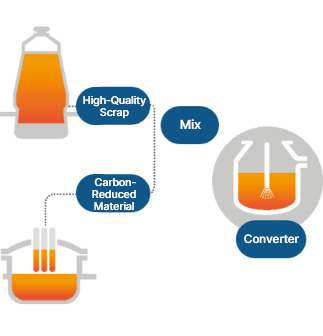
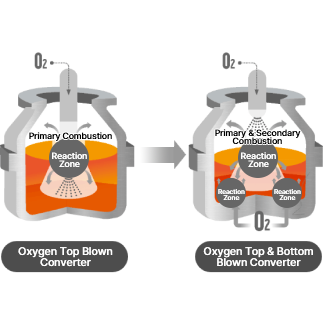
Technologies that enable the use of large amounts of scrap in place of hot metal, such as scrap melting and charging technology and top-bottom blowing converter technology, are collectively referred to low Hot Metal Ratio(HMR) operation technologies.
Scrap Usage(Domestic Operation)
| Category | Unit | 2024 | 2025 |
|---|---|---|---|
| Scrap usage | 10,000 tons | 688 | 681 |
| Purchased scrap | 10,000 tons | 205 | 203 |
| Self-sourced scrap | 10,000 tons | 483 | 478 |
3. POSCO's Hydrogen Reduction Ironmaking Technology(HyREX)
Hydrogen reduction ironmaking is a technology that reduces greenhouse gas emissions by replacing the coking coal used as a reducing agent and heat source in the ironmaking process with hydrogen.
Hydrogen-based ironmaking was designated a national strategic technology in January 2024, in recognition of its strategic importance to national security and its broad impact on the national economy. In May 2024, the Ministry of Science and ICT also selected the “development of iron-ore optimization technology for Korea’s hydrogen-based ironmaking (steel)” as a Global R&D Flagship Project.
POSCO is pursuing the Korean Hydrogen Reduction Ironmaking Demonstration Project in connection with national projects, targeting the completion of HyREX technology development by 2030. We plan to utilize HyREX as a core technology for achieving carbon neutrality in phases by 2050, on the premise of securing an economical and stable hydrogen and power infrastructure.
HyREX, our proprietary hydrogen-based ironmaking technology, is based on the fluidized reduction furnace technology of the already commercialized FINEX process. HyREX differs from the shaft furnace approach used by overseas steelmakers in both raw materials and equipment. In terms of raw materials, the shaft furnace uses iron ore processed into uniform pellets, whereas HyREX can directly use iron-ore fines, and is expected to offer advantages in raw material sourcing and production cost competitiveness. In terms of equipment, as a fluidized-bed reduction furnace method, HyREX has advantages over the shaft furnace in temperature control.
HyREX Features

Since 2021, we began the permitting process to develop the site for hydrogen-based ironmaking at Pohang Works, covering 1.35 million square meters. In March 2026 , we obtained approval from the Ministry of Land, Infrastructure and Transport. In July 2022, we signed a joint engineering agreement with Primetals, a company with FINEX facility design experience, and are jointly designing the main facilities of the HyREX demonstration plant. The demonstration plant under development at Pohang Works, with an annual production capacity of 300,000 tons, is scheduled to break ground in April 2026, with completion targeted for 2028. Through phased trial operations through 2030, we plan to secure optimal operating conditions and enhance the technical maturity required for transition to commercial facilities.
In 2023, our Technical Research Laboratories introduced a hydrogen fluidized reduction test furnace with a capacity of 50 kg per batch at the Pohang Technical Research Laboratories and verified hydrogen fluidized reduction technology. In April 2024, the Technical Research Laboratories completed an Electric Smelting Furnace (ESF) test facility with a capacity of one ton per hour at Pohang Works and achieved its first tapping. Through these efforts, POSCO established the foundation for developing the core technologies of the fluidized reduction furnace and the electric smelting furnace and for advancing HyREX technology.
We are also actively engaged in technology development partnerships to accelerate decarbonization across the global steel industry. Working with the World Steel Association and Swedish steelmaker SSAB, we led the International Hydrogen Ironmaking Forum (HyIS Forum) in 2021 and 2022, and from 2023 expanded it into the Breakthrough Technology Conference hosted by the World Steel Association. Separately, since 2023 we have organized and operated the POSCO-led HyREX R&D Partnership to build global consensus on HyREX technology. The HyREX R&D Partnership comprises 19 member companies, including global steelmakers, raw material suppliers, and energy companies, and held its first conference in November 2024. We plan to continue accelerating carbon reduction technology development in the steel industry through cooperation with global steelmakers.
Scope 3 Management
POSCO has disclosed its Scope 3 emissions each year through its sustainability report and has conducted third-party verification of Scope 3 emissions under the ISO 14064-31) verification standard.
1)Rules of use for validating greenhouse-gas statements
Preparing for the Energy Transition
POSCO is reducing the share of blast furnace operations to transition to a decarbonized system. We are preparing to shift our steelmaking process toward electric arc furnaces and hydrogen reduction ironmaking.
A decline in blast furnace operations also reduces the share of self-generated power that uses byproduct gas as an energy source. At the same time, total power consumption at the steelworks is expected to rise as energy-intensive facilities, such as fluidized reduction furnaces for hydrogen-based ironmaking, are introduced. We are therefore developing an energy transition strategy to meet customer demand for renewable energy-based products. In the short term, we are expanding our use of renewable energy by purchasing Green Premium certificates and Renewable Energy Certificates(RECs) under the K-RE100 scheme, thereby enabling the supply of steel produced with renewable energy in response to customer requirements.
In the long term, to secure the large volumes of carbon-free energy required for decarbonization, we are identifying options to expand investments in on-site renewable energy generation within our steelworks and to enter into long-term Power Purchase Agreements(PPAs) with renewable energy providers. Through these initiatives, we aim to build a stable carbon-free energy supply infrastructure to achieve carbon neutrality by 2050.
Investments in Industrial Transformation
POSCO is working to reduce carbon emissions in its steel production by constructing an Electric Arc Furnace at Gwangyang Works as part of its transition away from the existing blast furnaces. This shift to Electric Arc Furnace process is expected to significantly reduce carbon emissions compared with the existing blast-furnace process. POSCO is also investing in demonstration plant to commercialize hydrogen-based reduction ironmaking(HyREX), and plans to pursue a phased decarbonization strategy across the steel industry―leveraging Electric Arc Furnaces for near-term emissions reductions and introducing hydrogen-based ironmaking in the mid to long term.
Investment Activities
| Category | Key Details |
|---|---|
| New Electric Arc Furnace | · GHG reduction by building a new Gwangyang Electric Arc Furnace |
| Hydrogen-based Ironmaking(HyREX) Demonstration Plant | · Build demonstration Plant to verify HyREX technology |
Development of Carbon-Reduced Steel Products and Services
POSCO is developing low-carbon steel solutions to meet customers’ increasing decarbonization requirements. Scrap is an iron input that has already undergone reduction, meaning it does not require additional carbon-intensive reduction processes compared with iron-ore-based production. POSCO has developed a technology that increases the scrap ratio through a double scrap charging process in steelmaking, targeting approximately a 10%1) reduction in CO₂ emissions per ton of crude steel compared with existing blast furnaces production. In 2025, we began commercial sales of low-carbon steel using this double scrap charging technology, achieving sales of KRW 520 million.
We are also pursuing further emissions reductions through the construction of a large-scale Electric Arc Furnace, which is expected to deliver up to 75%2) lower CO₂ emissions compared with existing blast furnaces operations. Aligned with our 2050 Decarbonization Roadmap, we plan to expand scrap-based steel production through the operation of the new Gwangyang Works Electric Arc Furnace starting in 2026.
Low-Carbon Steel Lineup
| Core Technology | Carbon Reduction Target | Production Process |
|---|---|---|
| Two-Batch Scrap Charging | ↓10% 1) | Raise the scrap ratio by charging scrap twice in the steelmaking process |
| Large EAF | ↓75% 2) | Produce scrap-based steel with a new large Electric Arc Furnace |
1)The overall average reduction target versus the EPD carbon-emission intensity certified by the Ministry of Climate, Energy and Environment in 2022-2023 (reduction varies by product), subject to change based on third-party carbon-footprint verification before product launch.
2)Versus the 2017-2019 average, POSCO's baseline period for calculating carbon-reduction rates, subject to change depending on scrap supply conditions and the power-generation mix.
Low-Carbon Steel Sales
| Core Technology | Unit | 2024 | 2025 |
|---|---|---|---|
| Two-Batch Scrap Charging | KRW million | 0 | 520 |
Carbon Capture, Utilization, and Storage
① CCU(Carbon Capture, Utilization)
To reduce CO₂ emissions from its steelmaking processes, POSCO is exploring the adoption of CCUS1) technology, recognized as carbon capture and utilization technology under Article 2 of the Act on Promotion of Transition to an Environmentally Friendly Industrial Structure. Since 2021, POSCO has been conducting a public-private national R&D project with the Research Institute of Industrial Science & Technology (RIST) to demonstrate CO2 capture and conversion technologies. In January 2024, a demonstration at Pohang Works successfully validated a technology that separates and captures CO₂ generated in steelmaking processes and injects it into coke ovens as a heat source for by-product gas power generation. The results confirmed that coke-oven injection is feasible using medium-purity CO₂, without the need for energy-intensive purification to high-purity CO₂.
This process also increased the calorific value of coke oven gas (COG) by approximately 7%. COG is a versatile energy source used as fuel gas, a feedstock for by-product hydrogen production, and a raw material for high-value-added chemicals, with its utilization potential increasing alongside its calorific value. POSCO's CO₂ injection and conversion technology utilizing coke ovens was selected as one of the Top 10 R&D Technologies of 2024 by the Ministry of Trade, Industry and Energy (MOTIE), and approximately KRW 25 billion has been invested from 2021 to 2025 in the construction of demonstration facilities and technology validation. POSCO is also reviewing a project to produce 99.99% purity liquid CO₂ and sustainable aviation fuel (SAF) using by-product gases generated from its steelworks, with the aim of gradually expanding its industrial gas portfolio.
In 2024, POSCO established the Steel Industry CCU Consortium in partnership with LG Chem, the Korea Research Institute of Chemical Technology (KRICT), and Gyeongsangbuk-do Province, and joined the large-scale CO₂ capture and utilization project (CCU Mega Project) led by the Ministry of Science and ICT (MSIT). The consortium proposed Pohang Works as the demonstration site and received approval from MSIT in October 2024. Following selection for the preliminary feasibility study in January 2025, the project underwent evaluation and was officially approved for implementation in November 2025.
The CCU Consortium plans to capture approximately 16,000 tons of CO₂ annually from steelmaking processes at Pohang Works and demonstrate its conversion into syngas (a mixture of carbon monoxide (CO) and hydrogen (H₂)) and methanol. The produced syngas may be utilized either as a chemical feedstock for external supply or reintegrated into steelmaking processes, enabling improved resource efficiency and inter-process integration. Methanol can also be used as fuel and chemical feedstock, and is expected to support future demand for decarbonized energy and fuel transition.
② CCS (Carbon Capture and Storage)
POSCO plans to implement phased CO₂ capture using commercially proven technologies. The captured CO₂ will undergo compression, liquefaction, and purification to meet transport and storage specifications (-51°C, 5.5 bar, purity > 99.9%). It will then be injected into depleted oil and gas fields and saline aquifers with sealed geological formations for permanent storage. Sealed geological formations refer to subsurface structures in which impermeable cap rock overlies porous sedimentary formations, effectively preventing CO₂ leakage. Promising storage sites under review include the East Sea gas field in Korea, as well as locations in Southeast Asia, including Indonesia, and northwestern Australia. In parallel, we are also reviewing a method of reacting captured CO₂ with steelmaking slag to form carbonates and permanently store it as backfill material in abandoned mines.
In 2024, POSCO was selected for the Export-Import Bank of Korea’s International Feasibility Study Support Program and conducted a preliminary CCS feasibility assessment for PT. Krakatau POSCO (Cilegon, Indonesia), an overseas integrated steel mill. In 2025, a full feasibility study was carried out to further refine our CCS implementation strategy.
1)CCUS (Carbon Capture, Utilization and Storage): A technology that captures CO₂ emitted at large scale and either utilizes it directly for industrial purposes, converts it into high-value-added products, or permanently or semi-permanently sequesters it.
Participation in Climate Initiatives
POSCO has participated in the CDP (Carbon Disclosure Project) since 2003, transparently disclosing climate-related information. CDP requires companies to calculate and verify GHG emissions (Scope 1, 2, and 3), analyze climate-related risks and opportunities, and disclose reduction targets and performance results ― all of which POSCO fulfills. In 2025, we achieved a B rating in the Climate Change category.
Product and Service Life Cycle Assessment (LCA)
POSCO conducts life cycle assessments (LCAs) of its major steel products, including hot-rolled steel, cold-rolled steel, heavy plate, and electrical steel. Through the identification of environmental impacts across the full product life cycle, POSCO obtains Korean Environmental Product Declaration (EPD) certification, with the related certification status made available on a dedicated website.
Energy Efficiency Improvement and Energy Management & Audit
Energy Efficiency Management System
POSCO is shifting its energy management from a plant-level, cost-centered approach to a facility- and efficiency-centered one. We introduced a Factory Energy Management System (FEMS) at the hot-rolling plant and built a system that precisely analyzes energy-loss factors by linking facility-level energy measurement data with existing operating data. Based on the results of operating this energy-efficiency management system, we are expanding it to other plants in phases.
Energy Efficiency Improvement Activities
POSCO makes multifaceted efforts to enhance energy efficiency, including increasing power-generation efficiency within steel processes. To this end, we operate a dedicated energy-efficiency team that precisely diagnoses the energy efficiency of individual facilities. Building on these diagnostics, we pursue systematic activities integrating energy diagnostics, facility improvement, and investment planning ― including the introduction of high-efficiency pumps and inverter-controlled equipment, and the rationalization of aging, low-efficiency power generation facilities.
We also reuse by-product gases generated in steel processes ― such as blast furnace gas (BFG) and COG ― as fuel for processes and power plants. In particular, we have developed technology to predict by-product gas generation and utilization in real time, and continue to invest in facility improvements and R&D aimed at minimizing by-product gas venting and increasing recovery rates.
In 2025, we self-generated 88% of the electricity consumed at our steelworks through by-product gas recovery and waste heat reuse. We also hold an annual energy-saving idea contest at each worksite to develop improvement ideas. In 2025, outstanding ideas were discovered ― including optimization of reheating furnace operations and fuel switching for power facilities ― which we plan to further develop and implement in accordance with on-site conditions.
Energy Saving Target Management and Identification of Initiatives
POSCO continually identifies energy-saving tasks each year. Through its energy management system, we monitor energy use in real time and analyze usage patterns to find efficient ways to use energy, and we have made it a standard procedure to review rooftop-solar installation when investing in new plants with roof areas of 6,000 m² or more.
Power Facility Efficiency Improvement Project at Pohang and Gwangyang Works
POSCO operates self-generation facilities that use byproduct gas and natural gas generated during the steelmaking process. When a turbine generates electricity, a higher vacuum in the condenser―one of the key power facility components―increases the heat drop of the steam discharged from the turbine, thereby improving turbine efficiency.
To improve vacuum levels, POSCO is sequentially applying a Debris Filter, which removes foreign matter inside the tubes, and an automatic cleaning system―the CTCS (Condenser Tube Cleaning System)―to each generating unit. Following the application of this system to Pohang Unit 17, we confirmed an improvement of approximately 4.3% in energy intensity. A total of 17 such improvements have been completed across our Pohang and Gwangyang worksites through 2025, and we plan to continue expanding these improvements to further enhance energy efficiency going forward.
Blast Furnace Hot Stove Temperature Control Optimization Program
Producing molten iron in a blast furnace requires a continuous supply of ultra-high-temperature blast air exceeding 1,000°C. The hot blast supplied to the blast furnace is generated through a regenerative method that passes air through the hot stove's regenerator. Storing sufficient heat in the regenerator to maintain the target blast temperature is therefore central to improving thermal efficiency.
The Ironmaking Department and the EIC Technology Department at Gwangyang Works work to secure an appropriate blast temperature by optimizing hot stove temperature control for each operating environment, from Blast Furnace No. 1 to No. 5. As part of this effort, 10 furnace-specific custom control functions were newly developed and applied. The departments also identified the optimal pressure and mixed-gas calorific value to rapidly restore heat storage when levels decline in a specific hot stove, increasing the flexibility of blast temperature control. As a core facility directly tied to blast furnace operation, the development of this blast temperature control system has significantly contributed to operational stability by reducing blast temperature variation. The resulting improvements in thermal efficiency also enable reductions in mixed-gas consumption.
Renewable Energy Generation and Sourcing
Completion of the POSCO Fulfillment Center
In April 2024, POSCO completed the POSCO Fulfillment Center in the Gwangyang National Industrial Complex. The center features a 1.4 MW rooftop solar power facility capable of generating enough electricity to power approximately 500 households for a year. As of 2025, this supplies 20% of the center's total operating power from renewable energy.
We invested KRW 90 billion in the POSCO Fulfillment Center and broke ground in November 2022. The center spans 50,000 m²―roughly the size of seven soccer fields―and is equipped with 34,000 cells capable of storing materials ranging from small to large. Productivity is significantly enhanced through large-scale automated shelving that stores materials via crane, cube-type warehouses with robot-automated storage, and autonomous mobile robots. A Warehouse Management System(WMS) further optimizes efficiency across the entire workflow―from material storage to delivery history management―by leveraging data to forecast material demand and manage inventory.
Risk Management
Resilience Assessment
Methedology
S&P Global's climate-economics modeling methodology applies the SSP (Shared Socioeconomic Pathways) scenarios. The SSP scenarios are the new greenhouse-gas pathways used in the IPCC1)'s 6th Assessment Report (AR6, Working GroupⅠ), and they consider socioeconomic factors such as future population change, economic development, and urbanization alongside the RCP scenarios.
1)IPCC (Intergovernmental Panel on Climate Change)
SSP Scenarios
| Type | Worksite | Global temperature (end of 21st c.) |
|---|---|---|
|
SSP 1-2.6 |
A low-carbon scenario characterized by a sustainable socioeconomic structure with strong mitigation and adaptation capacity, driven by reduced social inequality and rapid development of eco-friendly technologies | +1.9°C |
|
SSP 2-4.5 |
A moderate-growth socioeconomic scenario assuming mid-level climate mitigation and socioeconomic development | +3.0°C |
|
SSP 3-7.0 |
A scenario characterized by a socioeconomic structure vulnerable to climate change due to uneven development and institutional constraints | +4.3°C |
|
SSP |
A high-carbon scenario characterized by a socioeconomic structure with weak mitigation capacity despite strong adaptation capacity, driven by the absence of climate policy, fossil-fuel-based growth, and high human investment |
+5.2°C |
Analysis and Results
POSCO derived the following results for Pohang Works, Gwangyang Works, PT.Krakatau POSCO (Indonesia), and POSCO YAMATO VINA (Vietnam). Under the SSP 5-8.5 scenario, the average annual projected loss rate from temperature extremes for the four worksites through 2040-2049 is expected to be between 1% and 5%, and for PT.Krakatau POSCO, drought is expected to cause an annual average loss rate of 1-5%. Projected loss rates from other risk factors were assessed at under 1%.
Physical risk scenarios by type, 2040-2049 (SSP 5-8.5 scenario applied)
Worksite |
Extreme Temperature | Inland Flooding | Coastal Flooding | River Flooding |
Drought |
Wildfire |
Typhoon |
Water Scarcity |
|---|---|---|---|---|---|---|---|---|
Pohang Steelworks |
1-5% | Less than 1% | Less than 1% | Less than 1% |
Less than 1% |
Less than 1% |
Less than 1% |
Less than 1% |
Gwangyang Steelworks |
1-5% | Less than 1% | Less than 1% | Less than 1% |
Less than 1% |
Less than 1% |
Less than 1% |
Less than 1% |
PT.Krakatau POSCO |
1-5% |
Less than 1% |
Less than 1% |
Less than 1% |
Less than 1% |
Less than 1% |
Less than 1% |
Less than 1% |
POSCO YAMATO VINA |
1-5% |
Less than 1% |
Less than 1% |
Less than 1% |
Less than 1% |
Less than 1% |
Less than 1% |
Less than 1% |
Climate Adaptation and Physical Risk Response
POSCO focuses on analyzing climate risks and opportunities and strengthening its adaptive capacity. In 2025, we pursued physical-risk response activities centered on the Pohang and Gwangyang works.
Physical Risk Response Measures
| Risk Type | Major Exposed Worksites | Key Response Activities in 2025 |
|---|---|---|
| River & Inland Flooding | Pohang Steelworks, Gwangyang Steelworks |
- Operation and enhancement of Pohang Steelworks' BCP-based flooding and disaster response system - Strengthening disaster prevention infrastructure at Gwangyang Steelworks, including flood barriers, drainage channels, and large-capacity pumps |
| Coastal Flooding | Pohang Steelworks, PT.Krakatau POSCO, POSCO YAMATO VINA |
- Maintenance and reinforcement of seawalls, revetments, and detached breakwaters at Pohang Steelworks - Maintenance of floodgates, flood barriers, and drainage facilities at PT.Krakatau POSCO (PT.KP) - High-ground equipment layout and regular dredging/maintenance of port drainage channels at POSCO YAMATO VINA (PY VINA) |
|
Comprehensive Monitoring |
All Worksites |
- Improvement of physical risk monitoring systems by worksite and regular re-evaluation |
POSCO considers climate risks in depth from the earliest stages of developing its business and investment strategies. We focus on strengthening climate resilience across all areas of management, including workforce, infrastructure, and energy. In particular, during the review process for new investments, we carefully assess the vulnerability and exposure of relevant regions and existing facilities to climate-related events. Based on these assessments, we establish measures to address risks associated with process water shortages, power supply disruptions, raw material supply constraints, and potential impacts on sales.
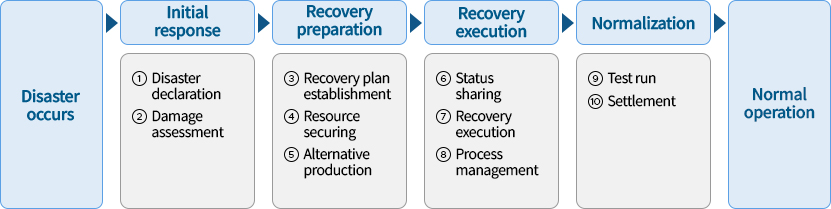
To ensure business continuity in the event of disruptions, we maintain a Business Continuity Plan (BCP), which includes a structured process covering damage assessment, investigation, recovery planning, resource mobilization, alternative production arrangements, information sharing, recovery execution, process management, and settlement.
Business Continuity Plan
Metrics and Targets
Metrics
GHG Emissions Measurement Methodology
POSCO calculates its GHG emissions using the operational control approach. The worksites and facilities under POSCO's direct operational control are defined and managed as the organizational boundary for GHG quantification.
GHG Measurement Approach
Category |
Measurement Approach |
|---|---|
Scope 1, 2 emissions |
- ISO 14064-1 / Guidelines on emissions reporting and verification under the Emissions Trading Scheme |
Scope 3 emissions |
- The Greenhouse Gas Protocol: Corporate Value Chain (Scope 3) Standard |
Scope of Worksites for Environmental Performance Disclosure
POSCO set all its domestic worksites (Pohang Works, Gwangyang Works, Seoul office, etc.) as the scope of environmental-performance disclosure, and the climate change response section and ESG Factbook were prepared to include domestic worksites and 10 overseas subsidiaries.
Targets
GHG Emissions Target
Under the 2050 Decarbonization Roadmap, POSCO aims to achieve carbon neutrality by 2050, with reductions of 10% by 2030 and 50% by 2040 against the base year.
Alignment with Recent Climate Agreements and Jurisdictional Targets
- National and international commitments (NDC) : POSCO implements its 2050 Decarbonization Roadmap in support of the government's Nationally Determined Contribution (NDC), setting out phased emissions reduction milestones relative to the 2017-2019 baseline average.
- Laws and regulations (ETS) : POSCO manages all Scope 1 and 2 emissions of its Korean entity and trades allowances to comply with its allowance-submission obligation under the Korea Emissions Trading Scheme (K-ETS).
- Zero-emission vehicle transition initiative (K-EV100) : POSCO participates in the Korea zero-emission vehicle transition project (K-EV100) led by the Ministry of Climate, Energy and Environment.
Energy Usage Target
Energy Targets and Performance
| Category | Unit | 2025 Target | 2025 Performance |
|---|---|---|---|
| Energy use* | TJ | 406,766 | 398,207 |